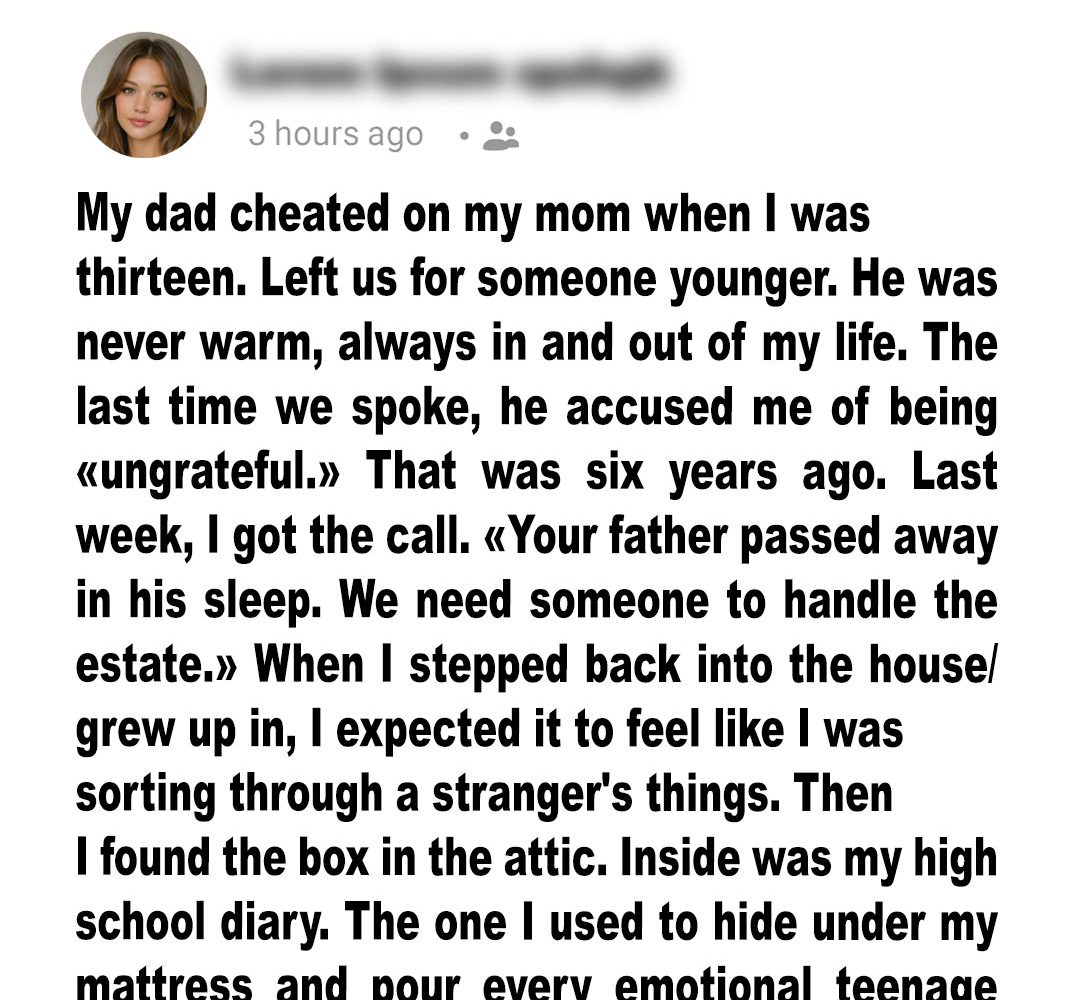
When Cara returned to her estranged father’s house after his sudden death, she expected nothing but dust, old memories, and a quick task of sorting through his things. Instead, she found her old teenage diary filled with her father’s secret, heartfelt handwritten replies in the margins. What she discovered completely changed how she saw the man she thought she knew — and brought a kind of healing she never expected, even after goodbye.
I hadn’t spoken to my father in six years when the call came. “Cara, I’m sorry,” Greta, the attorney handling his estate, said softly. “Your father passed away in his sleep. Someone needs to handle the house.”
I stared at my phone long after she hung up. Not because I was grieving. Not because I was in shock. But because deep down, I didn’t even know if I wanted to go back.
Philip and I never had the warm father-daughter relationship people write tributes about. He wasn’t cruel, but he was never truly warm either. He was the dad who bought bikes for Christmas but forgot birthdays in July. The dad who clapped the loudest at swim meets but never remembered my best friend’s name, no matter how many times I introduced her.
He was there — technically. But always at arm’s length.
When I was 13, everything shattered. He cheated on my mom and left us for someone younger. The cliché hurt more than anything. Not just because he left, but because he made our life together seem so easily disposable.
After the divorce, contact became rare and awkward — a lunch here, a late birthday text there. I learned to stop expecting him to show up. By college, even those small efforts faded. We drifted like strangers connected only by DNA.
The last time we spoke, six years ago, it ended badly. He accused me of being ungrateful. I shot back that he had no idea how to be a real dad and that he didn’t know who I was at all. That was it. No apologies. No closure. Just silence.
So when I pulled up to my childhood home years later, keys heavy in my hand and dread in my chest, I didn’t expect real emotion. I expected a cold, business-like task of clearing out what he left behind.
The house hadn’t changed much. Dust covered the picture frames. His scuffed shoes still lined the hallway. His favorite cracked coffee mug sat in the sink, as if he might walk in any moment to use it again.
But he wouldn’t.
I moved through the rooms mechanically, boxing up the evidence of a paused life. Memories tried to creep in — the way he whistled while making coffee, how he watched the Sunday news in silence — but I pushed them away.
Then I reached the attic.
The air was thick with dust and old paint. In the far corner sat a small cardboard box labeled in faded marker: “Books/Trophies/Random Items.”
Inside were old swim medals, yearbooks, and a broken Rubik’s Cube — fragments of my childhood mixed with his. Then, nestled at the bottom, I found it.
My high school diary. Navy blue, stickers peeling, edges frayed.
I hadn’t seen it in years. Opening it felt strangely intimate. I flipped through the pages, cringing at my teenage melodrama: “Why am I like this?” “I hate my thighs.” “I failed my chemistry test. I’m worthless.”
But then my smile faded. In the margins were tiny notes — not in my handwriting.
They were in Philip’s blocky, careful print.
They weren’t criticisms or jokes. They were gentle, loving responses:
“You are not unlovable, Cara. Not even close.”
“You don’t need to shrink to be worthy.”
“One test doesn’t define you. I’m proud of how hard you try.”
Tears sprang to my eyes as I turned page after page. Every self-hating entry from my teenage years had been met with his quiet kindness — words I never imagined he could offer.
The ink showed these notes were written long after I had left home. He had been reading my diary years later, during the time we weren’t speaking.
I sank to the dusty attic floor, overwhelmed. Had he sat here alone at night, flipping through my old words? Was this his only way of talking to me when I had shut him out?
Near the back, I found an unfinished entry from the week of my high school graduation. I had written about feeling lost, angry, and invisible to the people who should care most.
Beneath my jagged, broken-off sentences, Philip had written:
“I wish I had said these things when they mattered most.”
“I was a bad father, Cara. You didn’t deserve the silence.”
“This was the only way I could talk to you without you turning away. I hope someday you’ll forgive me.”
I read the words over and over, my chest tight with emotion. He had known all along how much he had hurt me. He regretted it deeply. In these secret margins, he had tried — in his flawed, too-late way — to make peace.
The anger I had carried for so long began to soften. Not gone completely. Not fully forgiven yet. But it shifted.
He hadn’t been the father I needed growing up. He was distant and imperfect. But in these quiet, hidden notes, he showed me he saw me, he cared, and he was sorry.
I spent hours in that attic, reading and rereading his words. The diary had become a tender conversation across years of silence — one final message from a man who couldn’t say it out loud while he was alive.
Clearing out the rest of the house felt different after that. The resentment I arrived with had lightened. In its place was a quiet sadness mixed with unexpected understanding.
Healing can come even after goodbye. Sometimes it arrives in the margins of an old diary, in words written by a father who finally found the courage to speak — even if it was too late for me to hear it from his lips.
What would you do if you discovered something like this about a parent you thought you knew? Have you ever found unexpected proof of love hidden in plain sight?