Eleanor Mitchell didn’t realize her son had lost the right to his father’s legacy the day Richard died.
It wasn’t in the hospital, not when the monitor flattened into a steady tone after months of illness. It wasn’t when the doctor walked in with that quiet, final expression. It wasn’t even when Richard held her hand and whispered,
“Do what’s right, not what’s easy.”
She understood it at the funeral.
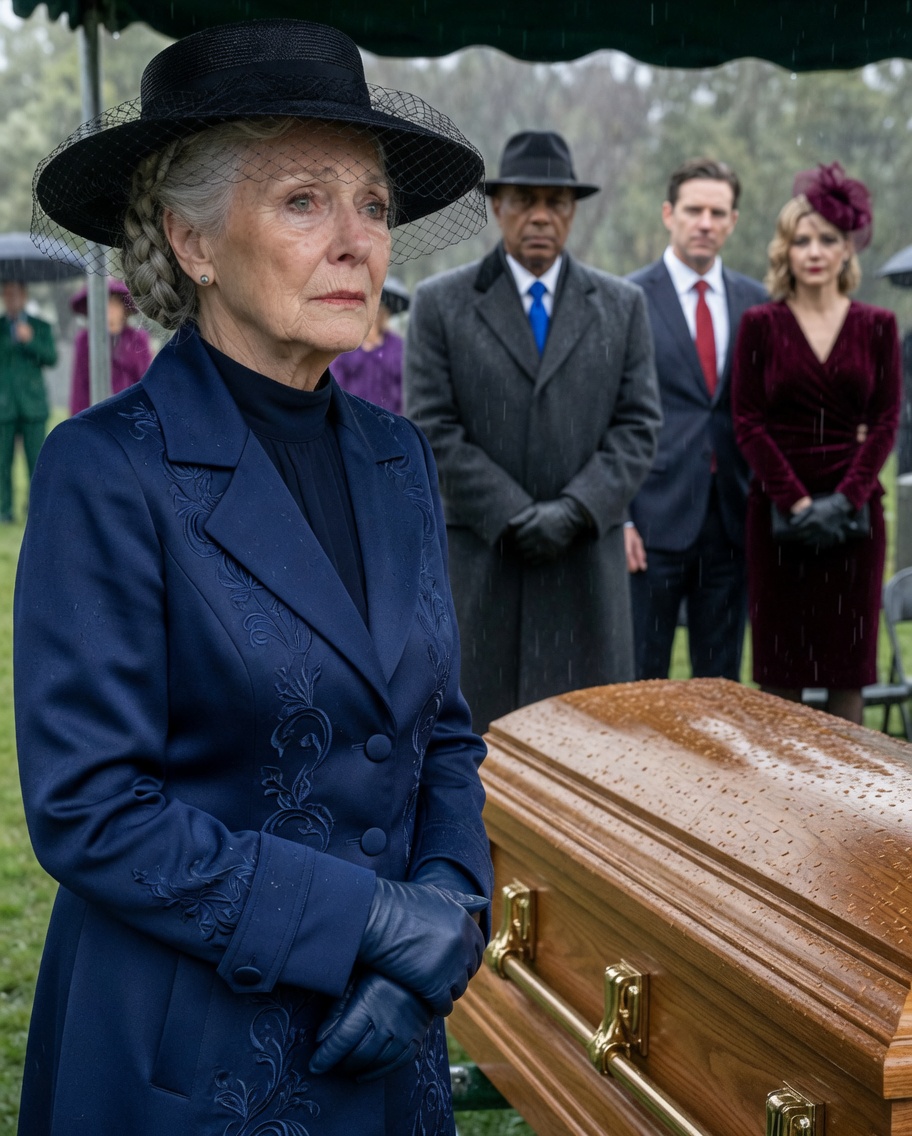
On a gray November afternoon, rain falling in cold sheets, Richard Mitchell—founder, husband, father—was laid to rest. Hundreds stood beneath black umbrellas.
But in the front row, beside Eleanor…
there was an empty chair.
It had been reserved for Thomas.
Their only son.
The boy Richard had raised, invested in, believed in—and defended long after excuses stopped sounding like youth and started sounding like character.
Thomas wasn’t there.
He had chosen to attend his wife’s lavish birthday party in Aspen instead.
And in that moment, Eleanor stopped lying to herself.
“Begin,” she told the pastor.
Her voice didn’t break.
The truth became law the next day.
At the reading of the will, Thomas arrived confident, expecting control of Mitchell Shipping—the billion-dollar empire his father built.
Instead, he heard something else.
A clause.
A condition.
His inheritance depended entirely on Eleanor’s judgment of his character.
“If his conduct proves unworthy,” the lawyer read, “the inheritance shall be redirected.”
Thomas frowned. “What does that mean?”
Walter, the attorney, turned to Eleanor.
“Mrs. Mitchell, do you wish to invoke the clause?”
The room went still.
Eleanor looked at her son—and saw him clearly.
Not the boy she raised.
Not the future Richard once imagined.
But a man who had walked away from his father’s burial for a party.
“Yes,” she said.
“I invoke the clause.”
Thomas lost everything.
Thirty percent went to the foundation.
Thirty percent to employee pensions.
Thirty percent to his daughter Charlotte.
Ten percent to Eleanor.
And Thomas?
He received his father’s first desk—a folding card table—and a set of books on ethics.
He fought back.
He filed a lawsuit.
He accused Eleanor of manipulation, grief, instability.
The media exploded.
“Son disinherited after missing funeral.”
“Billion-dollar family feud.”
But Richard had anticipated everything.
Video recordings. Documents. Witnesses.
In one recording, he spoke calmly:
“This isn’t about one day. My son is not ready. I gave him everything—except accountability. I will not risk thousands of lives depending on this company.”
Eleanor watched, tears falling quietly.
This wasn’t revenge.
It was responsibility.
Then everything collapsed for Thomas.
His wife left when the money disappeared.
His social circle vanished.
His reputation fractured.
For the first time in his life, there was nothing left to hide behind.
No wealth.
No power.
No illusion.
He dropped the lawsuit.
One morning, he came to see Eleanor.
No perfect suit. No polished confidence.
“Victoria’s gone,” he said.
Eleanor nodded gently.
“You were right,” he admitted. “She didn’t love me. She loved what I had.”
He placed a notebook on the table.
It was Richard’s.
Inside were not financial plans—but wishes:
That Thomas find purpose beyond wealth.
That he earn respect instead of inheriting it.
That he value Charlotte before she stopped waiting for him.
That he understand people are not tools.
That he come home before it was too late.
Thomas read in silence.
Then broke.
“I didn’t know him,” he whispered.
“You did,” Eleanor said softly. “You just didn’t listen.”
Thomas withdrew the lawsuit.
He apologized—not for forgiveness, but because it was necessary.
He resigned from the company.
And for the first time in his life…
he started at the bottom.
He joined his father’s foundation—not as a leader, but as a worker.
He visited schools, docks, and communities.
He listened.
A dockworker once told him:
“Your father knew every man’s name. You called us ‘labor units.’”
Thomas didn’t argue.
“I’m sorry,” he said.
And meant it.
His relationship with Charlotte took time.
“I don’t know what to say,” she told him.
“You don’t have to,” he replied. “I just need to do better.”
He didn’t ask for forgiveness.
He earned pieces of it.
A year later, they returned to the cemetery.
No storm. No crowd.
Just the three of them.
“I missed his burial,” Thomas said quietly.
“I don’t know how to live with that.”
“By becoming someone who would never make that choice again,” Eleanor answered.
Thomas never became CEO.
He never inherited billions.
But he built something he never had before:
A life he could stand in without shame.
People told the story wrong.
They said a mother disinherited her son over a funeral.
They said a billionaire punished his heir.
They said a fortune was lost.
All of that was true.
But it wasn’t the whole truth.
The truth was this:
A mother loved her son enough to stop rescuing him.
A father loved his legacy enough to protect it—even from his own blood.
A daughter refused to pretend absence didn’t hurt.
A man lost everything—and finally had the chance to become someone better.
Years later, a foundation center opened in Richard’s name.
It supported students, workers, and families.
Thomas stood on stage—not as an heir, but as someone who had learned.
“My father didn’t leave me money,” he said.
“He left me responsibility.”
Eleanor stood in the front row, hand over her heart.
She finally understood.
A legacy isn’t something you leave for people to spend.
It’s something you leave for them to become.
Thomas never got the empire.
But he got something far greater:
A second chance to earn his place in the world.
THE END