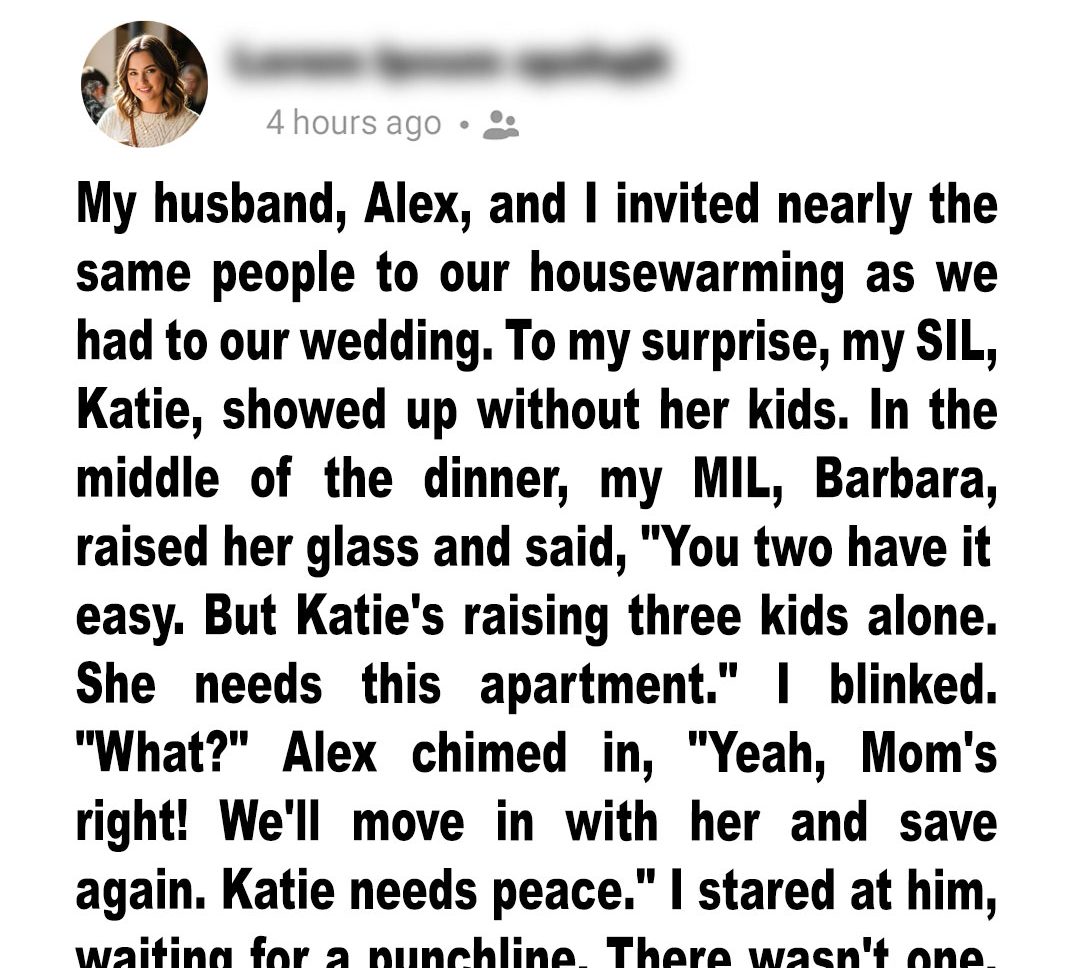
When my husband, Alex, and I hosted our housewarming party, I expected joy — laughter, new beginnings, and family celebrating together. What I didn’t expect was tension simmering beneath every smile.
At the dinner table, everything went sideways. My mother‑in‑law, Barbara, suddenly raised her glass and said something that hit like a shockwave: she insisted we move in with my sister‑in‑law, Katie, and her three kids, to “help her out.”
I blinked. My parents froze. Alex, right beside me, chimed in like this was the most natural suggestion: “Yeah, Mom’s right! We’ll live with her and save money. Katie needs peace.”
There was no punchline. No preparation. Just a room full of stunned faces. My heart thudded as it sunk in — this wasn’t a casual idea, it was a plan already in motion.
I looked at Katie, hoping for solidarity, but her silence was heavier than any argument. Eventually she whispered that she never asked us to move in — she only needed support, not an upheaval of our lives.
When I confronted Alex — quietly but firmly — about making life‑changing decisions without talking to me first, the tension stretched across the table like an invisible wall. Alex tried to justify it, but words stumbled and fell before they could land.
Barbara kept insisting it would be perfect — no rent, financial relief, and “so much easier for Alex to focus on his career.” Her cheerful insistence felt like a dismissal of my thoughts, my space, and my voice.
My blood churned. This was more than a conversation about living arrangements — it was a question of respect, partnership, and decision‑making as a team. And I realized that if we were going to make major life choices, it couldn’t be with half the information or without heart‑to‑heart communication first.
I softened my tone and suggested a compromise: “We don’t have to live together to help. We can support Katie — emotionally, financially, however she needs — but not at the cost of uprooting our own life.”
For the first time that evening, a small, grateful smile flickered across Katie’s face. Alex stopped circling around excuses and finally understood what I meant. He apologized, saying he got caught up in the “idea of helping” without thinking through how it affected us both.
By the end of the night, the mood had shifted. The uncomfortable cloud of assumptions and unilateral decisions began to lift. We didn’t leave with answers, but we left with a better understanding — that family support doesn’t require sacrificing our partnership.
As we drove home, I felt lighter — not because every conflict had been solved, but because we had walked through honest communication together. That night taught me this: the strongest foundations aren’t built on agreement, but on respect and honest conversation.